
Policy 24: Water Utility Cash Reserve Policy
Policy Objective:
The Board recognizes the need to develop access to liquid reserves, using financial targets as a guide to determining future revenue requirements. Funding levels may vary as circumstances dictate.
Policy Statement:
The Board intends to establish the types and levels of reserves needed to cover various risks and needs. These reserves, and their levels, are intended as guides only, and are meant to apply under normal circumstances. However, the Board intends to work with the General Manager to take the necessary steps to attain the reserve levels established in this board policy. The required reserves may be met by any combination of unrestricted cash, cash equivalents or external borrowing with a maturity of 12 months or more.
To help ensure timely completion of capital improvements and enable the utility to meet requirements for large unexpected expenditures, a minimum cash reserve policy will be established. Minimum cash reserves attempt to quantify the minimum amount of cash the utility should keep in reserve. Actual cash reserves may vary above the minimum and are dependent on the life cycle of assets currently in service. The minimum cash reserve calculation considers the risk “in total” and not each individual category. For example: the amount that the utility is required to expend to respond to an unanticipated catastrophic event may far exceed the amount set aside under the Contingency Reserve. Other Board designated funds in the remaining categories, unrestricted funds and short term financing would be options that may be used to address the expenditures related to an unanticipated catastrophe.
When establishing or adjusting minimum cash reserves for each of the reserve accounts identified in this policy, due consideration will be given generally to the following: operation and maintenance expense, rate base, capital improvements, and debt service. Additionally, for each reserve account component specific assumptions and factors will influence the amount of the reserve, as described in each category below:
- Annual Debt Service
Debt service payments do not occur evenly throughout the year and often occur at periodic times, typically every six months. It is the policy of the board that the utility maintains adequate cash reserves to fund the next occurring debt service payment when the payment is due. To ensure that adequate reserve levels are maintained, each month 1/12th of the debt service payment will be moved from working capital to the debt service reserve. - Working Funds Reserve
Because there are timing differences between when expenses are incurred and revenues are received from customers, a minimum working funds reserve helps ensure that the utility will have adequate liquidity (or working funds) to pay expenses in a timely manner. The working funds reserve will at all times be maintained at a minimum level equal to 12.3% (approximately 45 days) of annual operating expenses (excluding depreciation). - Special Capital and Major Maintenance Reserve
The purpose of the special capital and major maintenance reserve is to defray all or a portion of a future capital and major maintenance project or external expenditure that is not externally financed. A separate sub reserve for each project will be established. Each reserve will be funded over the number of years, and up to a certain amount of the project's planned total expenditures, as determined by the Board and the General Manager for each project. These reserves will be set up and used only as needed. - Contingency Reserve
Catastrophic events such as ice storms, wind storms, floods, or tornadoes may occur that require a substantial financial outlay by the utility to replace damaged assets. The percentage used to calculate the minimum cash reserves is dependent on the age of the assets in service and the level of risk of a catastrophic type event. The age of the assets in service will be computed by dividing the Net Book Value by the cost of Capital Assets to arrive at the Percent of Assets Depreciated. The contingency reserve will have a minimum funding amount equal to the product obtained when the Reserve Percent (shown below) corresponding to the Percent of Assets Depreciated is multiplied by the cost of Capital Assets as recorded in the financial statements
Percent of Assets Depreciated Reserve Percent Greater than 55% 3.0% 45% to 55% 2.0% Below 45% 1.0% - Capital and Major Maintenance Reserve
Because some capital improvements are funded through bond issuances and some are funded through cash reserves, the utility will maintain a capital and major maintenance project reserve to ensure timely replacement or construction of utility infrastructure. The capital and major maintenance reserve will include 20% of the cost of capital improvements anticipated during the following five years, less any improvements funded through the issuance of bonds, less any capital projects included in capital improvements specifically reserved in the Special Capital and Major Maintenance Reserve for the same period.
The General Manager will have the authority to move funds among all the reserves. When practical, the General Manager will consult with the Board before moving funds involving the Contingency Reserve. In that case he will report to the Board as soon as
practical when such transactions are authorized without first informing the Board.
Ordinarily, the order of replenishment among these reserves is as follows:
- Debt Service Reserve
- Working Funds Reserve
- Special Capital and Major Maintenance Reserve
- Contingency Reserve
- Capital and Major Maintenance Reserve
Annually at budget time the General Manager will recommend funding levels for each reserve. If anything causes actual reserve amounts to fall below the minimum levels described in this policy, the Board shall take action to restore the cash reserves to the minimum levels over the subsequent five years or revise this policy to discontinue certain reserves or adjust the minimum levels of the existing reserves.
The reserve levels described in this policy are meant to be long-term average balances, and it is understood that achieving the recommended reserve level may not occur immediately, thus jeopardizing the overall financial wellbeing of the utility. There will be times when the reserve balances will fall below the established minimum levels. The General Manager will advise the Board on various matters related to the reserves, such as whether a current deviation from the established acceptable levels is expected to be short-term or whether any action needs to be taken.
Policy Information
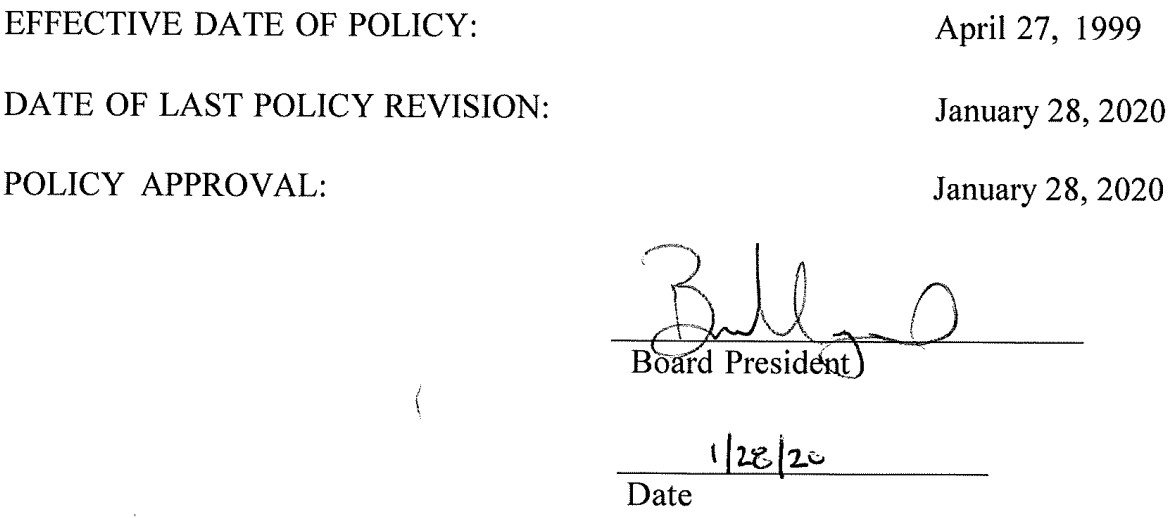
Effective Date of Policy: April 27, 1999
Last Reviewed: January 28, 2020
Last Approved: January 28, 2020
Signed By: Brian Morgan, Board President
Contact Us
RPU Service Center
4000 East River Rd NE
Rochester, MN, 55906
Business Hours
RPU Service Center Lobby Hours:
Monday-Friday 8am-4:30pm
RPU Customer Care by phone: 507-280-1500
Monday-Friday 8am-5pm
Report an Outage
Electric Outage: 507-280-9191
Water Outage: 8am-5pm:
507-280-1500
Water Outage: 5pm-8am:
507-280-9191